Continuing Disability Review Louisiana: Protecting Your SSDI and SSI Benefits
Key Takeaways
A continuing disability review is how the Social Security Administration checks whether you still qualify for social security disability benefits. If you receive SSDI or SSI in Louisiana, a CDR can threaten your income and medical coverage.
-
Missing deadlines, failing to respond promptly to SSA, or having weak medical records are the most common reasons Louisiana residents lose disability benefits during a CDR.
-
It is crucial to maintain regular medical treatment to document ongoing impairment during a CDR process.
-
Recipients must respond to all SSA notices and provide any requested information promptly to avoid losing benefits.
-
Changes in circumstances, such as employment, marital status, or income, should be reported to SSA to avoid benefit issues.
-
Coenen Law Firm in Monroe helps people throughout Louisiana—including Ouachita, Union, Morehouse, Richland, Caldwell, Jackson, and Lincoln parishes—fight CDR denials and keep receiving benefits.
-
You typically have just 10 days to request continued benefits and 60 days to file an appeal after a cessation notice.
-
Acting fast with an experienced Louisiana social security disability attorney can make the difference between keeping and losing your benefits.
If you received a CDR notice, call Ted Coenen at (318) 322-7004 for a free review or message us online .

What Is a Continuing Disability Review (CDR) in Louisiana?
A continuing disability review is the Social Security Administration’s process to determine if you still meet the disability rules for Social Security programs such as Social Security Disability Insurance (SSDI) or Supplemental Security Income (SSI). The SSA initiates a CDR by sending a notice and a report form, which can be either the Disability Update Report or the Continuing Disability Review Report depending on the expected improvement of the condition. CDRs apply to both adults and children, and Louisiana cases are processed through the state’s Disability Determination Services (DDS), which is responsible for evaluating medical records to determine if the conditions still meet federal standards.
A CDR is not the same as an overpayment notice or a new application. However, it can lead to your benefits being reduced or stopped if SSA believes medical improvement has occurred. Many Louisiana residents receive their CDR paperwork by mail and often have only 10 days from the notice date to respond if they want checks to continue during the review. During the CDR process, recipients must provide any requested information from SSA promptly to avoid interruptions in benefits.
If you received a CDR notice, call Coenen Law Firm at (318) 322-7004 immediately to understand what it means for your case.
How Often Does Social Security Do a CDR?
The timing of CDRs depends on whether Social Security expects your medical condition to improve. Your original award letter indicates which diary category applies to your case.
| Diary Category |
Expected Review Cycle |
|---|---|
| Medical Improvement Expected (MIE) |
Every 6–18 months |
| Medical Improvement Possible (MIP) |
Every 3 years |
| Medical Improvement Not Expected (MINE) |
Every 5–7 years |
| Conditions common in Louisiana—severe back injuries, stroke, heart disease, diabetes complications, and mental health disorders—are often categorized as MIP, meaning reviews every 3 years. |
For children on SSI, CDRs occur at least every 3 years and critically at age 18, when the child is reevaluated under adult disability standards. This transition point is where many young people lose eligibility without updated medical evidence.
Receiving a CDR notice does not mean you did anything wrong. CDRs are routine—but you should still take them seriously.
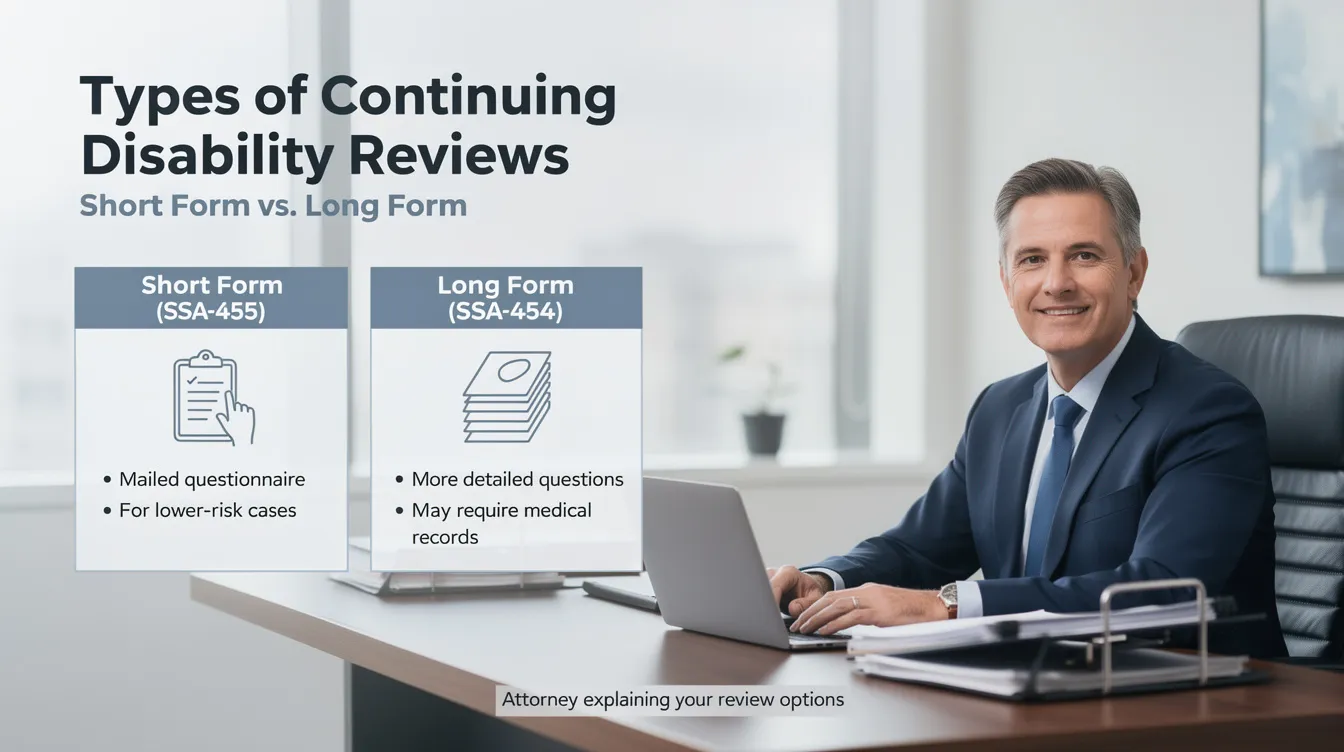
Types of Continuing Disability Reviews: Short Form vs. Long Form
Not every CDR looks the same. Some are lighter paper checks, while others are full reviews.
Short-Form CDR (SSA-455 Disability Update Report):
-
Sent to beneficiaries whose disabling condition appears stable
-
Contains mostly yes/no questions about work activity, medical treatment, and improvement
-
Usually processed within 90 days if no red flags appear
Long-Form CDR (SSA-454 Continuing Disability Review Report):
-
Much more detailed, covering all doctors, hospitals, medications, and daily limitations
-
Requires updated contact information for medical providers and recent test results
-
More likely to trigger a full medical review by Disability Determination Services
Even a short form can escalate to a full review if your answers suggest improvement, work activity, or gaps in treatment.
If you received the long form—or aren’t sure which form you have—call (318) 322-7004 so Coenen Law Firm can help you answer questions accurately.
What SSA Looks At During a CDR
SSA focuses on whether there has been medical improvement and whether you can now perform substantial gainful activity despite any improvement.
Main evidence SSA reviews:
-
Updated medical records from doctors, clinics, and mental health providers
-
Treatment consistency showing regular visits and following treatment plans
-
Objective tests like MRIs, nerve studies, cardiac tests, and psychological evaluations
-
Statements from you and third parties about daily activities and limitations
-
Work history and employment records
During a CDR, recipients must provide updated medical records and respond to all SSA notices, as failure to do so can lead to the termination of benefits.
For SSI recipients, financial eligibility is also reviewed during a CDR to ensure they still meet non-medical requirements based on income, resources, and living arrangements. Understanding how your income and available resources affect your eligibility is crucial, as exceeding limits can impact your benefits.
For 2026, the substantial gainful activity limit is $1,620 per month for non-blind individuals under full retirement age. Earning above this threshold can raise questions during your review.
SSA compares your current medical evidence against the “comparison point decision” from your original approval to determine if true improvement occurred. Louisiana residents who tried returning to work through vocational programs or ticket-to-work should seek legal assistance before or during a CDR.
Common Reasons Benefits Are Reduced or Stopped After a CDR
Many terminations are avoidable and stem from paperwork problems—not people suddenly getting healthy.
Frequent reasons for unfavorable CDR outcomes:
-
Missing the return deadline for CDR forms or ignoring follow-up letters
-
Incomplete medical records or listing only emergency room visits without regular follow-up
-
Treatment gaps that make it appear your condition improved (even if gaps were due to insurance or transportation issues)
-
Form statements that sound more functional than your actual day-to-day limitations
-
Unreported work or earnings appearing above SGA limits
-
Failing to report changes in circumstances, such as employment, marital status, income, or residency, which can result in benefit reduction or termination
For example, a person from Ouachita Parish who stopped seeing a cardiologist due to cost could face termination because SSA interprets the treatment gap as recovery. You have the right to explain why treatment lapsed, and an attorney can present this clearly.
If you received a “Notice of Proposed Termination” or cessation letter, call Coenen Law Firm immediately at (318) 322-7004 to discuss your appeal options.
How to Protect Your SSDI or SSI Benefits During a CDR
Careful preparation can significantly increase your chances of keeping benefits.
Maintain regular medical care:
-
See your primary doctor and specialists consistently, especially before and during a CDR
-
Ensure symptoms, side effects, and limitations are documented at each visit
Keep a symptom diary:
-
Record pain levels, missed work days, trouble sitting, standing, or concentrating
-
This helps you answer SSA questions accurately and supports your doctor’s notes
Complete your forms thoroughly:
-
List all medications, including over-the-counter
-
Provide updated medical records and complete contact information for every provider
-
Respond to every SSA letter on time and keep copies of everything you submit
It is important to plan ahead for future continuing disability reviews and possible changes in your benefits. Proactively strategize with your family and consider seeking professional guidance to help protect your eligibility and prepare for any potential benefit termination or medical evaluations.
If you feel overwhelmed, contact Coenen Law Firm online or call for guidance through each step.
Appealing a CDR Termination or Reduction in Louisiana
There are very short deadlines to appeal a CDR decision. Missing them can permanently harm your case.
Critical time frames:
-
10 days(plus mailing time) from the cessation notice to request that benefits continue during appeal
-
60 days from the notice date to file the formal appeal
Louisiana residents have 60 days to appeal a termination of benefits, and must appeal within 10 days to ensure benefits continue during the appeal process.
Appeal stages in CDR cases:
-
Reconsideration – A different DDS examiner reviews your case with additional information. In Louisiana, if your Social Security disability claim is denied, you can appeal the decision by requesting a reconsideration, which involves a new review by a Disability Determination Services examiner.
-
ALJ Hearing – If denied, you appear before an administrative law judge where testimony and medical experts may be involved. After an initial denial of Social Security disability benefits, the average wait time for a hearing before an Administrative Law Judge in Louisiana can be around 12 to 18 months.
-
Appeals Council Review – Further review if the ALJ’s decision is unfavorable. The Appeals Council reviews the case based solely on the existing evidence and the ALJ's decision, with no new testimony.
-
Federal Court – Final option in Shreveport or Baton Rouge divisions
The appeals process for a denied Social Security disability claim in Louisiana typically involves three major steps: a hearing with an Administrative Law Judge (ALJ), an appeal to the Appeals Council, and potentially a federal district court appeal.
Legal professionals can provide assistance throughout the appeals process, helping you navigate each step and improve your chances of success.
Keeping benefits during appeal can result in an overpayment if you ultimately lose, but many clients accept this risk to maintain income and medical coverage. Continued benefits during appeal can provide crucial financial support for recipients and their families.
If you received a cessation letter, call Coenen Law Firm at (318) 322-7004 right away to discuss your appeal strategy.
How Coenen Law Firm Helps with Continuing Disability Reviews
Ted Coenen’s Social Security Disability practice in Monroe focuses on helping clients navigate Social Security programs, including Security Disability Insurance (SSDI) and Supplemental Security Income (SSI), to protect ongoing benefits throughout North and Central Louisiana. The firm also handles worker’s compensation cases when disabilities overlap with workplace injuries.
Specific CDR assistance includes:
-
Reviewing CDR forms and notices, explaining them in plain language
-
Gathering and organizing updated medical records from local doctors and hospitals
-
Preparing clients to answer SSA questions honestly without hurting their case
-
Representing clients at reconsideration and ALJ hearings when SSA tries to stop benefits
-
Providing assistance at every stage of the continuing disability review and appeals process
The firm serves individuals in Ouachita, Union, Morehouse, Richland, Caldwell, Jackson, and Lincoln parishes, plus other Louisiana areas. Attorney fees follow SSA’s no-win-no-fee structure—no fee unless benefits are won or continued, capped at the standard SSA-approved amount.
Schedule a free consultation by calling (318) 322-7004 or sending a message through the online contact page .
Frequently Asked Questions About Continuing Disability Reviews in Louisiana
Will moving within Louisiana affect my Continuing Disability Review?
Moving between parishes does not change federal CDR rules, but you must update SSA with your new address. Failing to receive a mailed CDR packet due to an address change can lead to termination of benefits. Contact Social Security and notify your attorney whenever you move.
Does getting Louisiana Medicaid or Medicare change how SSA does a CDR?
Having Medicaid or Medicare does not prevent a CDR, but coverage helps maintain consistent treatment and records vital during review. Losing coverage can create treatment gaps that hurt your case. Keep copies of insurance cards and letters showing continuity of care.
What if I try to work while on disability and then get a CDR?
Social Security allows certain work attempts and trial work periods, but earnings above monthly limits can trigger questions. There are several rules governing work incentives and eligibility for Social Security benefits, so recipients should be aware of these before attempting to work. Keep careful records of hours and pay stubs. Before increasing work hours, talk with a Louisiana attorney about work incentives and risks.
Can children on SSI in Louisiana lose benefits after a CDR?
Yes. Children face CDRs and can lose benefits if SSA believes the condition improved. To remain eligible for benefits, children must continue to meet specific criteria during the review. At age 18, the unmarried child is evaluated under adult eligibility rules, which are often harder to meet. Family members should speak with an attorney before this transition.
How soon should I contact a lawyer after getting a CDR notice?
Contact a social security disability attorney as soon as the CDR packet arrives—not after a denial. Waiting makes it harder to fix form mistakes, gather missing records, or file for continued benefits. Call Coenen Law Firm at (318) 322-7004 or message us online immediately.