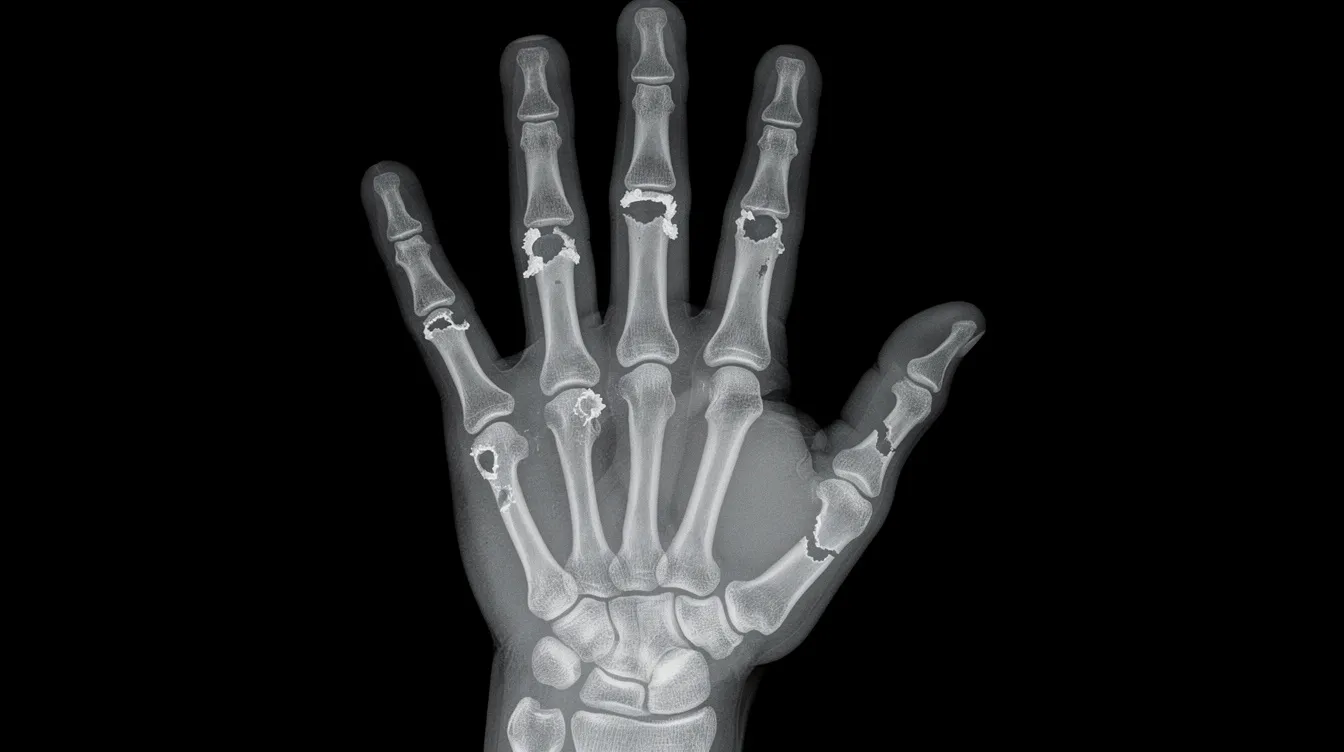
SSDI for Back Pain Louisiana: How Coenen Law Firm Helps You Qualify
Introduction
This guide explains how Louisiana residents with severe back pain can qualify for Social Security Disability Insurance (SSDI), what evidence is needed, and how legal representation can help. If back pain is keeping you from working, understanding the SSDI process is crucial to securing benefits. High denial rates for SSDI for back pain in Louisiana make it especially important to know what the Social Security Administration (SSA) looks for and how an experienced attorney can improve your chances of approval. This page is for Louisiana residents suffering from chronic or severe back pain who are considering applying for SSDI and want to know how to build a strong claim.
Key Takeaways
-
Severe back pain from conditions like herniated discs, spinal stenosis, degenerative disc disease, or failed back surgery can qualify for social security disability benefits in Louisiana if it prevents you from working full-time for at least 12 continuous months.
-
The Social Security Administration evaluates functional limitations—how long you can sit, stand, lift, and whether you need to lie down—along with objective medical evidence like MRIs and surgical records, not just your diagnosis.
-
Many strong Louisiana back pain claims are denied at first but later approved on appeal, especially when a local social security disability attorney builds comprehensive medical and work history evidence.
-
Ted Coenen represents back pain SSDI clients throughout North and Central Louisiana, including Monroe, Ouachita, Union, Morehouse, Richland, Caldwell, Jackson, and Lincoln Parishes.
-
If chronic pain prevents you from working, call Coenen Law Firm at (318) 322-7004 or message us online for a free SSDI case review.
Can Severe Back Pain Qualify You for Social Security Disability Insurance (SSDI) in Louisiana?
Chronic low back pain is one of the most common reasons people in Monroe and across Louisiana can no longer work and seek disability benefits through social security disability insurance. SSDI for back pain in Louisiana is a frequent query because musculoskeletal disorders, including back problems, make up over one-third of SSDI approvals nationwide.
However, Social Security does not pay benefits for mild or short-term back pain. Your medical condition must prevent substantial gainful activity for at least 12 continuous months or be expected to last that long.

Common Louisiana workers affected include:
-
Construction laborers and plant workers
-
Truck drivers along I-20
-
Nurses and aides who do heavy lifting
-
Warehouse and offshore workers
-
Oilfield and logging workers
-
Home health aides
Whether your back pain qualifies depends on how it significantly limits a person's ability to sit, stand, walk, bend, lift, concentrate, and show up reliably for an 8-hour workday, 5 days a week. The SSA evaluates a person's ability to perform work-related activities when determining eligibility for SSDI benefits.
Even if your specific back pain diagnosis is not listed as an impairment in the Social Security Administration's Blue Book, many Louisiana claimants still qualify for SSDI benefits if their symptoms are severe enough to significantly limit their ability to work.
If your claim is based on chronic pain, it's important to know that chronic pain itself is not a medically determinable impairment; to qualify for SSDI based on chronic pain, you must demonstrate how it limits your ability to work.
If you cannot keep working because of back pain, call (318) 322-7004 for a free SSDI consultation or reach out through our contact page .
Next, we’ll review the most common back conditions that may qualify for SSDI in Louisiana.
Common Back Conditions That May Qualify for SSDI
Social Security doesn’t simply look at the words “back pain” on your application. Instead, examiners review underlying medical diagnoses documented in your medical records through laboratory findings and clinical examinations.
Specific spine and back conditions often seen in Monroe-area SSDI claims include:
-
Herniated discs or bulging discs in the lumbar or cervical spine
-
Degenerative disc disease with joint space narrowing
-
Spinal stenosis narrowing the spinal canal
-
Spondylolisthesis (vertebra slipping forward)
-
Scoliosis with severe curvature impairing mobility
-
Failed back surgery syndrome after procedures like fusion or discectomy
-
Chronic radiculopathy with leg pain and numbness
-
Vertebral fractures from accidents or falls
-
Back injuries from workplace incidents
Combinations of conditions can be especially disabling. For example, degenerative disc disease paired with obesity and rheumatoid arthritis, or chronic pain inducing secondary depression that affects your nervous system and concentration, should all be documented.
Even if your exact diagnosis is not a listed impairment in the SSA Blue Book, you may still qualify for social security if your functional limitations are as severe as those from spinal disorders that are listed.
Next, we'll look at how the SSA evaluates these conditions and what evidence is needed.
How the SSA Evaluates Back Pain: Listings and Functional Limits
The Social Security Administration uses both the Blue Book spinal listings and a detailed review of what you can still do physically—your residual functional capacity (RFC).
The Social Security Administration maintains a Listing of Impairments, known as the Blue Book, which outlines medical conditions considered severe enough to prevent a person from working, including musculoskeletal disorders.
SSA evaluates whether a medical condition meets or equals a listing in the Blue Book, which includes specific criteria for various conditions, and requires objective testing to establish disability status.
Key elements from spine listings (like 1.15 and 1.16) include:
-
Nerve root compression confirmed by imaging
-
Spinal cord compromise with neurological symptoms
-
Reduced range of motion and muscle weakness
-
Serious limits in standing, walking, or using arms and legs
-
Laboratory findings related to nerve function
SSA examines your functional limitations:
| Functional Area |
What SSA Looks For |
|---|---|
| Standing/Walking |
Less than 2 hours per 8-hour day |
| Sitting |
How long before needing position changes |
| Lifting |
Less than 10 pounds frequently |
| Assistive Devices |
Need for cane, brace, or walker |
| Pain Management |
Medication side effects like drowsiness |
| Attendance |
Missing work several days monthly |
Real-world examples include needing to lie down 2-3 times during the day, severe pain even with medication, or neurological disorders causing balance problems.
Only about 20-30% of claimants meet a listing exactly. Most back pain approvals come through RFC assessments showing that, given your age, education, and past relevant work, there are no jobs in the national economy you can perform on a sustained basis.
In the next section, we’ll discuss the essential medical evidence needed for a successful SSDI claim for back pain in Louisiana.
Essential Medical Evidence for Louisiana Back Pain SSDI Claims
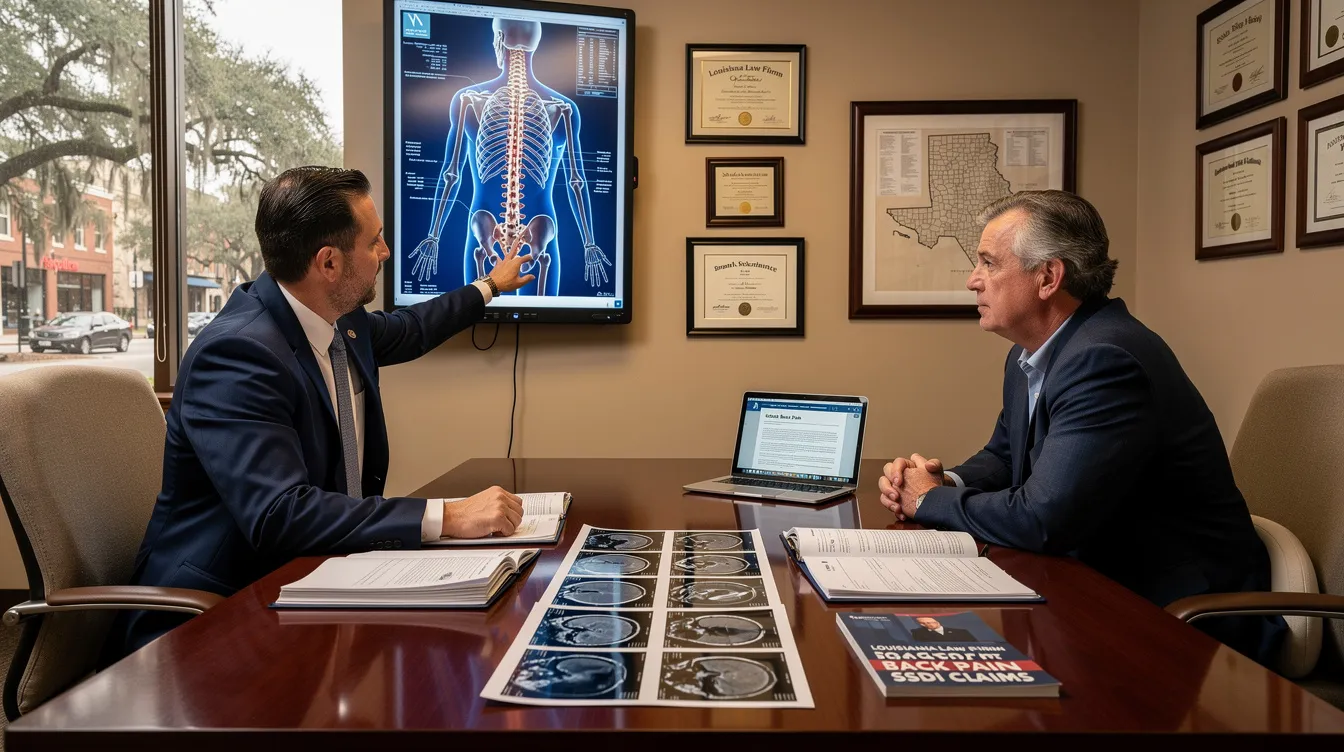
Objective medical evidence is critical because SSA will not approve SSDI for back pain based on your testimony alone, regardless of how honest you are about your condition affects your daily life.
Types of Medical Evidence
-
MRI or CT scans showing herniated discs, stenosis, or nerve compression
-
X-rays documenting degenerative changes, fractures, or spondylolisthesis
-
EMG/nerve conduction studies confirming radiculopathy
-
Surgical records from fusions, laminectomies, or disc procedures
-
Epidural injection records showing treatment attempts
-
Physical therapy notes documenting failed conservative treatment
-
Pain management clinic records with medication history and test results
Importance of Consistent Treatment
Regular treatment and consistent documentation of pain-related complaints in your chart notes are essential—not just at the first visit, but throughout your care with Monroe-area providers.
Treating physician opinions matter. Written statements explaining your lifting limits, how long you can sit or stand, whether you must elevate your legs, or how often you would miss work strengthen your disability claim significantly.
Coenen Law Firm helps clients gather necessary documentation from clinics and hospitals in Monroe, West Monroe, Ruston, Bastrop, and surrounding parishes to build a complete file.
Next, we’ll explain the work credit requirements and how your employment history affects SSDI eligibility.
SSDI and Work Credits: Are You Eligible Based on Your Work History?
To qualify for Social Security Disability Insurance (SSDI), you must have enough work history, typically 40 credits, with 20 credits earned in the last 10 years, and a medical condition that prevents substantial gainful activity for at least 12 consecutive months.
When applying for Social Security Disability Insurance (SSDI) benefits, your work history is just as important as your medical condition. To qualify for social security disability, you must have earned enough work credits through jobs covered by Social Security. These work credits are the foundation of SSDI eligibility and determine whether you can receive disability benefits if you become unable to work due to a severe medical condition.
Work Credit Requirements
Work credits are earned based on your annual wages or self-employment income. In 2026, you receive one work credit for every $1,890 you earn, up to a maximum of four credits per year. Most adults need 40 work credits to qualify for social security disability insurance, with at least 20 of those credits earned in the 10 years immediately before your disability began. However, younger workers may qualify with fewer credits, depending on their age at the time they became disabled.
How to Document Your Work History
The Social Security Administration (SSA) reviews your work history alongside your medical records to determine if you meet the SSDI eligibility criteria. If you have a disabling condition—such as degenerative disc disease, herniated discs, traumatic brain injury, chronic pain, or neurological disorders like multiple sclerosis or amyotrophic lateral sclerosis (ALS)—the SSA will also assess whether your condition significantly limits your ability to perform substantial gainful activity (SGA). For 2026, SGA is defined as earning more than $1,690 per month for non-blind individuals.
To support your disability claim, you’ll need to provide thorough documentation, including medical evidence, laboratory findings, and a detailed work history. The SSA will use this information to determine if your condition prevents you from working and if you have enough work credits to qualify for social security disability benefits. If your initial claim is denied, you have the right to appeal and submit additional evidence.
Navigating the application process can be complex, especially when it comes to gathering the necessary documentation and understanding how your work credits affect your eligibility. Working with an experienced social security disability attorney or advocate can make a significant difference. They can help you determine if you have enough work credits, ensure your medical records are complete, and guide you through each step of the process to maximize your chances of approval for SSDI benefits.
If you’re unsure whether your work history qualifies you for SSDI or have questions about your eligibility, don’t hesitate to reach out for professional guidance. With the right support, you can confidently pursue the disability benefits you deserve and focus on your well-being.
Next, we’ll discuss how your age, work history, and the SSA’s medical-vocational rules affect your SSDI claim for back pain.
Work History, Age, and the Medical-Vocational Rules
Most SSDI back pain approvals come through medical-vocational allowances, where SSA considers your age, education, and work history along with your back limitations—not just whether you meet a listing.
Heavy, physically demanding past work common in North Louisiana—construction, logging, oilfield, warehousing, nursing assistant positions—often makes it harder to determine whether you can switch to a light sit-down job after a serious back injury.
Age significantly impacts your case:
| Age Range |
Impact on SSDI Claim |
|---|---|
| Under 50 |
Must prove inability to adjust to any work |
| 50-54 |
More favorable if lacking sedentary skills |
| 55+ |
Highly advantageous for unskilled heavy laborers |
Older workers over 50 from physical trades with limited transferable skills have more favorable grid rules. Coenen Law Firm uses these rules to argue for approval when your ability to adjust to different work is limited by your well being, education, and physical restrictions.
Detailed job descriptions are crucial. Documenting how much you actually lifted, how long you were on your feet, and how often you bent or climbed shows why you cannot return to your past work in Ouachita, Union, or Lincoln Parishes.
Next, we’ll outline the five-step disability process used by SSA for back pain claims.
The Five-Step Disability Process Applied to Back Pain
Every Louisiana social security disability claim, including those for back pain, is decided using the same five-step process administered by Disability Determination Services (DDS) and, if appealed, an administrative law judge.
Step-by-step breakdown:
-
Gainful Activity Check: Are you working over the 2026 SGA level ($1,690/month for non-blind claimants)?
-
Severity Assessment: Is your back impairment severe and expected to last 12+ months?
-
Listing Evaluation: Does it meet or equal a spinal listing in the Blue Book?
-
Past Work Analysis: Can you do your past relevant work given your RFC?
-
Other Work Determination: Can you perform any other work in the national economy?
Example: A 55-year-old former warehouse worker in Monroe with lumbar stenosis who cannot lift more than 10 pounds, cannot stand more than 30 minutes, and must lie down several times daily would likely pass Steps 1 and 2, not meet Step 3 listings, fail Step 4 (cannot return to medium exertional past work), and at Step 5, grid rules may preclude sedentary work due to age and profile—resulting in approval.
Coenen Law Firm builds each case with this framework in mind, ensuring your file addresses every question SSA must answer about your person’s ability to work.
Next, we’ll discuss why back pain claims are often denied in Louisiana and how appeals can help.
Why Back Pain Claims Get Denied in Louisiana—And How Appeals Help
Approximately 65-70% of initial claim applications in Louisiana, including many strong back pain cases, are denied at first. However, many are later approved on appeal with proper representation.
Common reasons for denial:
-
Gaps in treatment history
-
Missing imaging records or laboratory findings
-
Earning over SGA income limits
-
Not clearly describing limitations on SSA forms
-
DDS assuming you can perform light or sedentary work
The 60-day deadline for each appeal level is strict. Starting over with a new application instead of appealing can cost you months of backpay and reset your disability began date.
Coenen Law Firm’s approach to appeals includes:
-
Reviewing denial letters to identify weaknesses
-
Gathering new MRI or specialist evidence
-
Obtaining updated treating physician opinions
-
Preparing detailed hearing testimony about pain and daily limitations
-
Cross-examining vocational experts about unrealistic job suggestions
If you received a denial for your back pain social security disability claim, contact Coenen Law Firm immediately at (318) 322-7004 or send a message online to protect your appeal deadlines.
Next, we’ll explain how Coenen Law Firm helps back pain claimants throughout Louisiana.
How Coenen Law Firm Helps Back Pain Claimants in Monroe and Across Louisiana
Ted Coenen is an experienced advocate and social security disability attorney based in Monroe who focuses his practice on SSDI and workers compensation cases for injured and disabled workers throughout North and Central Louisiana.

Services for back pain SSDI clients:
-
Evaluating whether your back condition meets or equals a spinal listing
-
Advising about when to file your initial claim
-
Completing and submitting SSDI and appeal forms
-
Gathering MRIs, treatment records, and medical professional opinions
-
Working with your doctors on functional capacity statements
-
Preparing you for hearings before an administrative law judge
Coenen Law Firm represents clients from Ouachita, Union, Morehouse, Richland, Caldwell, Jackson, and Lincoln Parishes and is familiar with local SSA offices, DDS practices, and regional hearing processes.
Initial consultations are free. Attorney fees are only paid from approved past-due SSDI benefits—no upfront payment required under federal fee rules.
Call Ted Coenen today at (318) 322-7004 or contact us through our contact page to discuss your SSDI options.
Next, we’ll outline the steps you should take now if back pain is keeping you from working.
What to Do Now if Back Pain Is Keeping You From Working
If you believe your back pain prevents you from working, take these steps:
-
Keep treating regularly with a primary care doctor, orthopedist, neurosurgeon, or pain management specialist
-
Follow through with recommended imaging and therapies—don’t skip appointments
-
Document how pain affects daily activities like standing, sitting, driving, and sleep
-
Avoid working over the SGA earnings limit while pursuing SSDI
Don’t wait until you’re completely out of work or resources before asking about social security disability insurance SSDI benefits. Earlier legal guidance can protect your onset date and potential backpay, which can average $15,000-$30,000 in lump sum monthly payments.
Many Louisiana workers with severe disabling conditions have successfully qualified for SSDI with the right evidence and legal help. You can get a personalized review of your claim by calling Coenen Law Firm at (318) 322-7004 or using our online message form.
Next, we’ll answer some frequently asked questions about SSDI for back pain in Louisiana, including how to apply.
Frequently Asked Questions About SSDI for Back Pain in Louisiana
How do I apply for SSDI in Louisiana?
Applicants in Louisiana can apply online, by phone, or in person for SSDI. You can start your application on the Social Security Administration website, call the SSA at 1-800-772-1213, or visit your local Social Security office. Coenen Law Firm can help you prepare your application and ensure all necessary documentation is included.
Do I need an MRI to win an SSDI case for back pain?
SSA strongly prefers objective imaging like MRI or CT scans because back pain is otherwise difficult to measure. Abnormal findings showing herniated discs, stenosis, or nerve root compression significantly strengthen your claim. However, you may still succeed without an MRI if you have strong clinical exams, X-rays, nerve studies, and long-term treatment notes from a medical professional. Coenen Law Firm reviews existing imaging and helps identify when additional testing might support your case for qualifying disability status.
Can I work part-time and still get SSDI for back pain?
You generally cannot receive supplemental security income or SSDI benefits if you earn over SSA’s substantial gainful activity limit—about $1,690 per month for non-blind claimants in 2026. Some limited part-time work below SGA may be permitted, but it raises questions about your ability to maintain full-time employment. Anyone considering working during the application process should consult with Coenen Law Firm first to avoid mistakes that could jeopardize their disability benefits.
How long does it take to get SSDI for back pain in Louisiana?
Initial decisions typically take 3-6 months. Reconsiderations add several more months. Hearing-level appeals can take 12-18 months depending on backlogs. Complete applications with all medical evidence submitted early help avoid delays. If approved, you may receive backpay going back to your established onset date, subject to a 5-month waiting period, which Coenen Law Firm will help document.
Will my age matter in an SSDI back pain case?
Age is crucial under SSA’s medical-vocational rules. The rules become more favorable after age 50 and especially after 55, particularly for workers from physical trades with limited education. Younger claimants can still win but face closer scrutiny about whether they can adjust to lighter work despite mental conditions or physical limitations from conditions like traumatic brain injury or vision problems. Coenen Law Firm evaluates each case using grid rules to show how age and work history support disability.
What does it cost to hire Coenen Law Firm for an SSDI back pain case?
SSDI fees are contingency-based under federal rules: no upfront fee, and the attorney is paid only if successful, typically from a portion of past-due benefits at a capped percentage. Consultations are free. For questions about fees or conditions like multiple sclerosis, amyotrophic lateral sclerosis (lou gehrig’s disease), early onset alzheimer’s disease, pancreatic cancer, acute leukemia, cystic fibrosis, heart failure, or other major body systems issues beyond mental illness, call (318) 322-7004 or use our online contact form for a clear explanation before you decide whether to work with our social security disability advocates and establish your work credits toward ssdi eligibility criteria for your co workers and yourself.